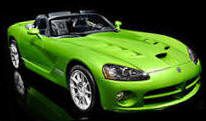
The Gen 3 and Gen 4 Viper represented a complete reinvention of the car ΓÇö new body, new chassis, and a significant leap in both power and build quality over the original generations. Badged as the SRT-10, these years brought the Viper into the modern performance car era.
Gen 3 (2003ΓÇô2006): A Complete Redesign
Gen 3 introduced an entirely new, rounder body style, a fully redesigned chassis, and an 8.3L V10 producing 500 horsepower. Build quality and interior refinement improved substantially over Gen 1/2, and the car launched convertible-only before the coupe returned in 2006.
Key specs:
– Engine: 8.3L V10, 500 hp / 525 lb-ft
– Transmission: 6-speed manual (Tremec T-56)
– 0-60: approximately 4.0 seconds
– Body: Convertible (2003-2005), Coupe returned 2006
Gen 4 (2008ΓÇô2010): More Power, Track Focus
Gen 4 bumped displacement to 8.4L, raising output to 600 horsepower, and introduced the ACR (American Club Racer) trim ΓÇö a track-focused variant with a functional wing, adjustable coilovers, and stripped-down interior options for serious track drivers.
Key specs:
– Engine: 8.4L V10, 600 hp / 560 lb-ft
– Transmission: 6-speed manual (Tremec T-56)
– ACR trim: Adjustable KW coilovers, functional aero, track-tuned suspension
– Production paused after 2010, returning with the all-new Gen 5 in 2013
Common Issues on Gen 3 & 4 Vipers
Serpentine Belt Wear
More frequently reported on these years than earlier generations, particularly on cars with added accessory loads like superchargers or aftermarket pulleys.
[Shop Serpentine Belts →]
Crank Sensor Failure
Intermittent stalling, rough idle, or no-start conditions are often traced to a failing crank sensor on Gen 3/4 cars ΓÇö a relatively affordable fix if caught early.
[Shop Crank Sensors →]
Front Sway Bar Link Wear
Clunking noises over bumps or reduced handling precision often point to worn sway bar links, especially on cars used for spirited or track driving.
[Shop Sway Bar Links & Caps →]
For full maintenance intervals and DIY repair guidance, see the [Dodge Viper Maintenance Guide].
Buying a Gen 3 or Gen 4 Viper: What to Check
– Confirm ACR vs. standard trim on Gen 4 ΓÇö this significantly affects suspension components and resale value
– Check belt and accessory drive condition, especially on modified cars
– Inspect for aftermarket tunes, which can mask or accelerate wear on ignition and crank sensor components
– Verify convertible vs. coupe body on Gen 3, as some trim and structural parts differ
Parts Compatibility Notes
Gen 3 and Gen 4 share the same body and chassis platform, meaning many exterior and interior parts are interchangeable. However, engine and some drivetrain components differ due to the displacement increase from 8.3L to 8.4L ΓÇö always confirm engine spec before ordering engine-specific parts.
[Shop All Gen 3 & 4 Viper Parts →]
Frequently Asked Questions
What is the difference between Gen 3 and Gen 4 Viper?
Gen 4 (2008-2010) increased displacement to 8.4L and horsepower to 600, up from Gen 3’s 500 hp 8.3L V10, and introduced the track-focused ACR trim with adjustable coilovers and functional aero.
What years is the Dodge Viper SRT-10?
The SRT-10 badge applies to Gen 3 (2003-2006) and Gen 4 (2008-2010) models, both featuring the redesigned body and chassis introduced in 2003.
What is the ACR Viper?
ACR stands for American Club Racer ΓÇö a track-focused trim introduced in Gen 4 (2008-2010) featuring adjustable KW coilovers, functional aerodynamic elements, and track-tuned suspension.
Why was there no 2007 Dodge Viper?
Production paused between the 2006 and 2008 model years while Dodge developed the updated 8.4L engine and ACR trim introduced with Gen 4.