
Dodge Viper History: From Concept to Cult Classic
Part of our Dodge Viper: Everything You Need to Know series.
The Viper wasn’t supposed to happen the way it did. It started as a wild concept nobody was sure Chrysler would actually build, and it ended, 25 years later, as one of the most distinctive American sports cars ever put into production. Here’s the full story.
The Concept: 1989
The Viper began life as a concept car unveiled at the 1989 Detroit Auto Show, conceived as Chrysler’s answer to the classic Shelby Cobra — a stripped-down, brutally powerful roadster with no pretense of luxury. The response was immediate and enthusiastic enough that Chrysler greenlit a production version almost right away, a rare occurrence for a concept this extreme.
Carroll Shelby himself, the man behind the original Cobra, was brought in to help develop and market the car — a fitting connection given how directly the Viper drew on that same philosophy.
The First Generation: 1992–1995
The production Viper RT/10 debuted at the 1991 Detroit Auto Show and reached customers for the 1992 model year. Under the hood was a massive 8.0-liter V10 developed with help from Lamborghini, then also under Chrysler ownership, producing 400 horsepower and 465 lb-ft of torque.
That was enough for a 0–60 time of roughly 4.6 seconds and a top speed north of 160 mph, numbers that beat the contemporary base Corvette and Porsche 911 Carrera 2.
True to its Cobra-inspired roots, the original Viper was deliberately minimalist: no exterior door handles, no side windows — just vinyl curtains — no ABS, no airbags, and no real concessions to comfort. It was, by design, a car that demanded respect from its driver.
Refinement Begins: Gen 2 (1996–2002)
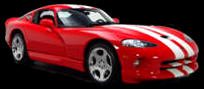
The second generation smoothed off some of the Viper’s roughest edges without diluting its character. The GTS Coupe arrived with its distinctive double-bubble roofline, chassis rigidity improved significantly, and horsepower climbed as high as 450 by the end of the run.
The Viper was becoming a more complete car while staying true to its original mission.
A Complete Redesign: Gen 3 & 4 (2003–2010)
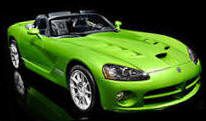
2003 brought a full redesign — a new body, new chassis, and a bump to 500 horsepower from an enlarged 8.3L V10. Gen 4, arriving in 2008 after the engine grew again to 8.4L, pushed output to 600 horsepower and introduced the track-focused ACR trim, the most extreme Viper variant built up to that point.
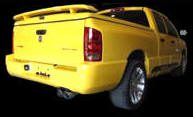
This era also produced the Viper’s unlikely spinoff: the RAM SRT-10, which placed the Gen 3 Viper’s V10 into a pickup truck from 2004 to 2006, briefly making it the fastest production truck in the world.
The First Ending and a Comeback: 2010–2013
Production paused after the 2010 model year — the first sign of the pressures that would eventually end the Viper for good. But the story wasn’t over yet.
The Viper returned for 2013 with an entirely new fifth generation, developed under the internal codename “Stryker.”
The Final Generation: Gen 5 (2013–2017)
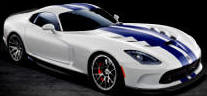
The Gen 5 Viper was, by most measures, the best Viper Dodge ever built — a completely modern chassis, up to 650 horsepower in ACR trim, and for the first time in the car’s history, standard electronic stability and traction control.
Trims ranged from the comfort-oriented GTS to the track-focused ACR and the ultra-limited 1:28 Edition, named for its record-setting lap time at Laguna Seca.
It was also, ultimately, the car’s last chapter. See our full breakdown of why the Viper was discontinued for the specific regulatory and market pressures that ended production in 2017.
Life After Production
The Viper’s story didn’t fully close with the factory doors. Dodge quietly sold small numbers of remaining new-old-stock Vipers years after production ended — in 2023 and again in 2024 — closing out inventory from a car nobody was making anymore.
Meanwhile, values on well-kept examples, particularly rare ACR and 1:28 Edition trims, have held remarkably strong, and the ownership community around the car remains as active as ever.
For more on whether the nameplate itself might ever return, see Is Dodge Bringing Back the Viper?
Where to Go Next
If you’re new to the Viper or trying to figure out which generation you own or want, our Generations & Buying Guide breaks down the specs and identifying features of every year in detail.
Frequently Asked Questions
The concept debuted in 1989, and the first production Viper RT/10 reached customers for the 1992 model year.
Five, produced across 1992–2017 with a production pause between 2010 and 2013, plus the related RAM SRT-10 truck variant from 2004–2006.
It was developed by Chrysler’s design and engineering teams, with Carroll Shelby — creator of the original Shelby Cobra that inspired the Viper’s concept — brought in to help develop and market the car.
Its deliberately minimalist, uncompromising design philosophy — a massive naturally aspirated V10, no driver aids in early models, and a focus on raw performance over comfort, at a time when most rivals were adding convenience features.