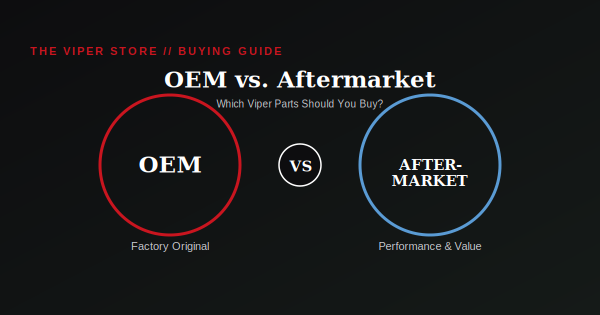
OEM vs. Aftermarket Viper Car Parts: Which Should You Buy?
Part of our Viper Car Parts Buying Guide series.
Every Viper owner eventually faces this decision: replace a worn or broken part with an original factory component, or upgrade to an aftermarket alternative. Here’s how to think through it, since the right answer changes depending on the part and your goals for the car.
What “OEM” Actually Means
OEM (Original Equipment Manufacturer) parts are made to the exact factory specification — the same part, or a direct equivalent, to what came on the car originally. For Vipers, genuine OEM availability varies enormously by generation: Gen 5 parts are still relatively accessible, while many Gen 1/2 OEM components have been fully discontinued by Chrysler.
What “Aftermarket” Actually Means
Aftermarket parts are made by third-party manufacturers rather than Chrysler. This covers a huge range — from parts that exactly replicate factory specifications, to performance-oriented upgrades that intentionally improve on the original design.
When OEM Is the Better Choice
- Collector or low-mileage cars where originality directly affects value.
- Cosmetic and trim parts where exact factory fit and finish matters for resale.
- Cars being kept as close to numbers-matching as possible.
When Aftermarket Makes More Sense
- Known factory weak points — many aftermarket parts are specifically engineered to fix design issues the factory part had (a common example: upgraded clutch components built to handle more torque than factory units).
- Track or performance-focused cars where originality isn’t the priority.
- Parts that are fully discontinued and simply unavailable as genuine OEM anymore, making aftermarket the only real option.
- Budget-conscious repairs where a quality aftermarket part costs meaningfully less than a hard-to-find OEM equivalent.
A Practical Framework
Ask these three questions before deciding:
- Does this part affect collector value or originality? If yes, lean OEM where available.
- Is this a known weak point on my generation? If yes, a purpose-built aftermarket upgrade may outperform the original design.
- Is genuine OEM even available? For many Gen 1/2 components, this question answers itself — aftermarket or used OEM becomes the only realistic path.
Where This Applies Across Common Parts
| Part Type | Generally Better Choice |
|---|---|
| Clutch components | Aftermarket (addresses known wear issues) |
| Exterior trim & emblems | OEM where available (affects resale/originality) |
| Suspension & brakes | Aftermarket for performance use, OEM for stock preservation |
| Interior trim | OEM where available (visible, affects presentation) |
| Air intake & exhaust | Aftermarket (designed for meaningful improvement over stock) |
Frequently Asked Questions
It depends on the part and your goals — OEM is generally better for collector value and originality, while aftermarket often makes more sense for known factory weak points, performance upgrades, or parts that have been fully discontinued.
Not necessarily — many aftermarket parts are engineered specifically to address known weaknesses in the original factory design, and quality varies by manufacturer rather than by OEM-vs-aftermarket status alone.
For many Gen 1 and Gen 2 components, no — Chrysler has discontinued a significant share of early Viper OEM parts, which is why specialist retailers and quality aftermarket alternatives become essential.